


A higher percentage on a serum label can look like a shortcut to better results, but it tells you less than it seems to. A higher percentage of an active ingredient only helps up to the point where your skin can use it, after which it either does nothing extra or starts causing irritation. Niacinamide, vitamin C and retinol all behave this way: the formulation around the active, its pH, and how your skin tolerates it count for as much as the figure printed on the bottle.

If you've stood in front of a shelf comparing two serums, one at 5% and one at 10%, and assumed the higher number must work harder, you're not alone, and the instinct makes sense on the surface. Percentages feel like a measurable fact in a category full of vague promises. The trouble is that skincare chemistry does not scale neatly with concentration, and a bigger number can just as easily mean more irritation as more benefit.
Does a Bigger Number Mean Better Results?
Not reliably. Every active ingredient has a concentration range where it does useful work, and pushing past that range tends to add irritation rather than extra benefit. Industry guidance on formulation puts it plainly: effectiveness depends on an active's threshold concentration, its pH environment, molecular weight and how well it suits the rest of the formula, not on reaching for the biggest number available, as explained in this overview of active ingredient concentrations.

When Can Increasing the Amount of an Active Help?
Raising the percentage of certain actives can genuinely improve what a serum delivers, within limits. Research into cosmeceutical ingredients has found that some actives show a clear threshold concentration below which they simply don't produce a measurable effect, meaning a formula under that line may underperform regardless of how well it's otherwise built, according to this review of cosmeceutical ingredient evidence. Retinoids are a useful example: comparisons between different retinol strengths have shown measurable differences in outcome, which is why dermatologists sometimes step patients up gradually rather than starting at the top strength.
Why Can Benefits Level Off as Irritation Increases?
Beyond a certain concentration, most actives stop delivering additional benefit and start causing more redness, stinging or dryness instead. This is a recognised pattern in formulation: a higher concentration doesn't always mean better results and can tip into irritation well before it delivers extra improvement, as in-cosmetics' analysis of ingredient percentages notes. Your skin barrier has a finite capacity to process an active ingredient in a given application, and once that capacity is exceeded, the surplus is more likely to irritate than improve.
What Does a Percentage on the Label Actually Tell You?
A percentage on a label tells you how much of something is in the bottle, but rarely tells you whether that something is the active ingredient itself or a blend that only partly consists of it. UAE and GCC shoppers increasingly expect brands to state concentrations, but a number alone doesn't confirm form, purity or how available that ingredient is to your skin.

Is the Percentage for One Ingredient or a Blend?
A stated percentage sometimes refers to a single pure ingredient and sometimes to a pre-mixed complex that contains it alongside carriers, stabilisers or other actives. A serum labelled "10% vitamin C complex" is not making the same claim as one labelled "10% L-ascorbic acid", because the complex version may contain a fraction of that 10% as the actual active. Without knowing which is meant, two serums with seemingly identical numbers can contain very different real-world doses of the ingredient you're actually looking for.
Can an Ingredient List Reveal How Much Is in a Serum?
An ingredient list shows order, not exact quantity, which limits what you can work out from it. Ingredients are listed in descending order by concentration, so the ones nearer the top make up a larger share of the formula, but there's no requirement to disclose the precise percentage of each one outside specific regulated actives.
Why Can Serums with the Same Percentage Perform Differently?
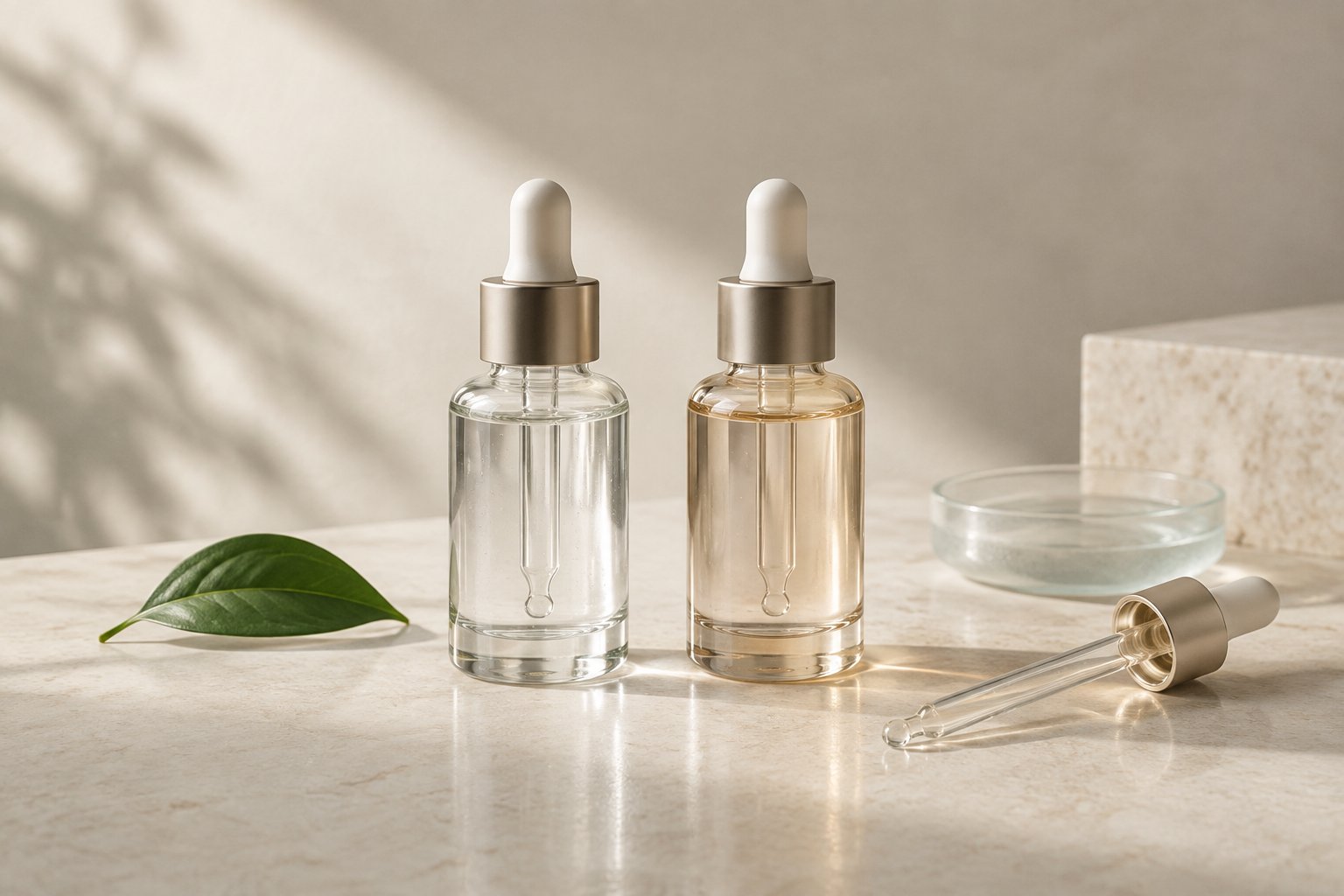
Two serums can list the same active at the same percentage and still behave in completely different ways on your skin. The ingredient's chemical form, the formula's pH, how stable the active remains in the bottle, and what else is in the mix all shape the result as much as the number on the label does.
How Do Ingredient Form, pH and Stability Affect a Formula?
The specific chemical form of an active, and the pH it's formulated at, determines how effectively your skin can actually use it. Vitamin C is a well-known case: L-ascorbic acid needs a low pH to remain stable and penetrate skin effectively or it breaks down easily and is less effective. Derivatives such as Ascorbyl Methylsilanol Pectinate, are more stable and maintain effectiveness without breaking down easily, but work differently and at different effective ranges. A serum that degrades quickly once opened, because it's poorly stabilised or packaged in clear glass exposed to light, can lose potency well before the bottle is empty regardless of its starting percentage.
What Role Do the Other Ingredients Play?
The supporting ingredients in a formula influence how well the active ingredient is absorbed, tolerated and delivered to the right layer of skin. Humectants, emollients and penetration enhancers all affect how a formula feels and performs, and a well-designed delivery system can make a lower percentage active more effective than a poorly designed formula at a higher one. This is part of why formulation quality, not concentration alone, is treated as the real measure of a product's worth, something reflected in analysis of skincare formulation performance across different product categories.
How Do You Choose a Strength That Suits Your Skin?
Match the strength to your specific concern, your skin's current tolerance and how the rest of your routine is built, rather than picking the highest number on the shelf. These three factors matter more than the percentage printed on any single bottle.
Match the Ingredient to Your Concern, Not Just the Number
Start with what you're trying to address, then look at whether the ingredient is appropriate for that concern at all, before worrying about strength. A serum such as Oil No More is built around an avocado-derived active with salicylic acid for oil control, while something targeting pigmentation, such as Oxy Bright Shield, leans on different actives entirely. So, chasing a percentage on the wrong ingredient for your concern won't help regardless of its strength.
Account for Skin Sensitivity and the Rest of Your Routine
Sensitive skin, or a routine that already includes other actives, lowers the strength your skin can comfortably handle at any one time. Layering a high-percentage active with another potent ingredient can increase irritation risk, so it helps to understand how to layer skincare correctly before adding a new strong serum to an existing routine.
Introduce a New Serum Gradually and Reassess
Start a new serum a few times a week rather than daily, and watch how your skin responds over several weeks before deciding it's too weak or too strong. Mild redness or dryness in the first week often settles as your skin adjusts; if irritation persists beyond that, the formula or the concentration may simply not suit you yet, regardless of what the label promises.
Choose the Formula, Not Just the Percentage
A serum's value comes from the whole formulation, its active's form, the pH it's set at, the supporting ingredients and how well it suits your skin, not from a single number on the front of the bottle. Percentages are a starting point for comparison, useful for distinguishing a serum clearly under-dosed from one in a sensible working range, but they stop being a reliable guide once ingredients, skin tolerance and formulation quality enter the picture. Reading labels with this in mind, and giving a new product several weeks before judging it, puts you in a stronger position than chasing the highest percentage on the shelf.
Frequently Asked Questions
Is 10% Niacinamide better than 5%?
Not necessarily. Niacinamide is generally well tolerated at both strengths, but some people experience more flushing or irritation at higher concentrations without a corresponding increase in benefit, so the better choice depends on how your skin responds rather than the number alone.
Does a higher percentage serum work faster?
Not reliably. Speed of visible change depends more on the specific ingredient, its form and how consistently you use the product than on a higher percentage, and some high-strength actives need a longer adjustment period before results become noticeable.
Can a stronger serum irritate my skin?
Yes. Pushing an active ingredient beyond the concentration your skin can comfortably process is a common cause of redness, stinging and dryness, and this risk tends to rise with concentration for actives such as retinoids, vitamin C and exfoliating acids.
Is it better to use a lower-strength serum regularly?
Often, yes. Consistent use of a lower-strength serum that your skin tolerates well tends to deliver steadier results over weeks and months than a high-strength product used sporadically because of irritation, since skin benefits from sustained, tolerable use rather than occasional intense exposure.

