


Smooth a few drops of serum over your face and, within a minute or so, the surface feels dry, perhaps a little tacky, then barely there at all. It is tempting to picture the whole formula soaking downwards like water into a sponge. What happens is more selective, and far more interesting: much of the liquid that carries the ingredients evaporates, some ingredients settle on the surface to hold water or form a light film, and a smaller share moves into the upper layers of your skin, where many of them do their most useful work.

So what happens after you apply a serum? The stratum corneum, the outermost layer of your skin, forms the main part of your skin barrier. Beneath it lie the deeper, living layers of the epidermis. Many serum ingredients remain within the outermost layer, while others can penetrate further. A serum works effectively when its ingredients reach the areas where they can best deliver their intended benefits. Depth on its own tells you very little about results.
Once you see where ingredients go, choosing a serum for hydration, oiliness or uneven tone becomes far less confusing. You can judge marketing claims more calmly, apply products in a sensible order and stop worrying about whether your skincare is "sinking in" fast enough.
From the Surface to the Skin Barrier
Your skin's first few hundredths of a millimetre decide what happens to almost everything you apply. A thin, tightly organised outer layer controls which ingredients pass and how quickly, and the feeling of a serum disappearing tells you about evaporation far more than about delivery.
Why Does a Serum Feel as Though It Has Sunk In?
Most serums are water-based, with water, glycerin and other solvents acting as the vehicle that carries the active ingredients. As soon as the serum is spread thinly over warm skin, much of that water starts to evaporate. In the UAE, where indoor air conditioning dries the air while outdoor humidity swings widely, you will notice this happening faster on some days than others.
What remains is a concentrated layer of the less volatile ingredients: humectants such as hyaluronic acid and glycerin, film-forming polymers, lipids and the actives themselves. Some of these bind to the surface, some begin moving into the outer skin, and some sit there until you wash them off. That "absorbed" sensation is mostly the vehicle leaving and the residue thinning out to a film you can no longer feel.
How Does the Stratum Corneum Control What Gets Through?
The stratum corneum - the outermost layer of the epidermis, is remarkably thin: 10 to 20 micrometres, made of flattened dead cells (corneocytes) set in a lipid matrix of ceramides, cholesterol and free fatty acids. The structure is often described as bricks and mortar, with the cells as bricks and the lipids as mortar. It also forms the basis of the skin barrier.
This arrangement is what keeps water in and most things out. Ingredients cross it by three main routes:
-
Intercellular: winding through the lipid "mortar" between cells, the main path for small, moderately oil-loving molecules.
-
Transcellular: passing through the cells themselves, which means repeatedly crossing watery and oily zones, a difficult route for most molecules.
-
Appendageal: travelling down hair follicles and sweat ducts, which bypasses part of the barrier but covers only a small share of the skin's surface.
Because the skin barrier is mostly lipid, a water-loving molecule has a hard time partitioning into it, while a very oily molecule may enter the lipids readily and then struggle to move on into the watery living tissue below.
What Is the Difference Between Penetration and Absorption?
The two words are used interchangeably in skincare marketing, but they describe different events:
|
Term |
What it means |
Relevance to serums |
|---|---|---|
|
Penetration |
An ingredient enters the skin, usually the stratum corneum or epidermis |
Often the goal for actives that act on skin cells |
|
Permeation |
An ingredient passes through one layer into the next |
Relevant for ingredients meant to reach the living epidermis |
|
Systemic absorption |
An ingredient reaches blood vessels in the dermis and enters the circulation |
Largely undesirable for cosmetics, and limited for most ingredients |
When you read "serum absorption" or "skincare absorption" in casual writing, it almost always means penetration into the skin, not entry into your bloodstream. Keeping that distinction in mind removes a lot of unnecessary worry.
Which Skin Layers Can Ingredients Reach?
Your skin has three layers. The epidermis includes the stratum corneum and, beneath it, living cells: keratinocytes, which build the barrier, and melanocytes, which produce pigment. The dermis holds collagen, elastin and blood vessels, and is the main site where substances enter the circulation. The hypodermis, the deepest layer, is mostly fat and connective tissue.
Most cosmetic ingredients are designed to act in the stratum corneum or the living epidermis. A smaller number of small, well-formulated molecules reach the upper dermis in modest amounts. The hypodermis is essentially out of reach for skincare, and it has no need to be reached.
Why Different Ingredients Work at Different Depths
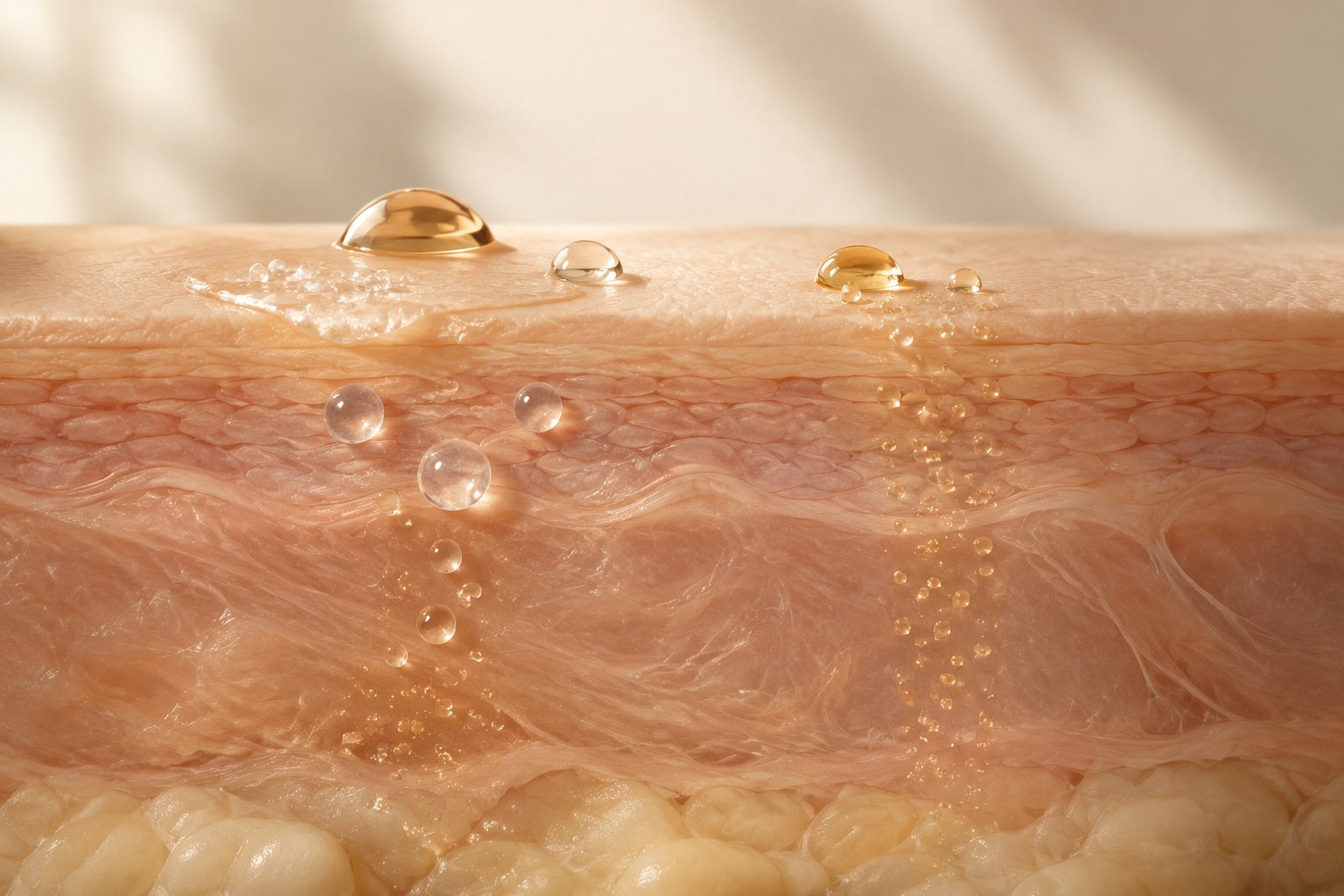
Each ingredient has a "home" layer where its job makes sense. Humectants help most at the surface, exfoliating acids act in the outer cell layers and pores, and ingredients such as vitamin C, niacinamide and retinoids need to reach living cells to influence how they behave.
Why Can Hyaluronic Acid Help Without Reaching Deep Skin Layers?
Hyaluronic acid is a humectant: it holds water. Standard high molecular weight forms are far too large to cross the stratum corneum, so they stay on the surface, binding water and forming a light, flexible film that reduces moisture loss and makes skin feel smoother and more comfortable within minutes.
That surface effect is valuable in its own right. A well-hydrated stratum corneum is more supple, fine dehydration lines look softer, and the barrier functions better. Low molecular weight hyaluronic acid, the form used in Lift & Plump by All About Serums™, is smaller and penetrates the upper layers more readily than the large form. Its ingredient-level purpose is hydration within the outer skin; it is not a route to replacing hyaluronic acid in the dermis, and no topical form has been shown to do that in a way you would see.
How Do Vitamin C, Niacinamide and Retinoids Differ?
These three are all small enough to enter the skin, but they behave very differently once formulated:
-
Vitamin C (ascorbic acid): water-loving and unstable. It rapidly degrades in water, at high pH and in the presence of oxygen and metal ions, so much of a vitamin C serum's quality depends on keeping the molecule intact long enough to reach the epidermis. Many products use more stable derivatives, such as Ascorbyl Methylsilanol Pectinate instead.
-
Niacinamide: also water-loving, but stable and well tolerated. It works in the epidermis, where it supports barrier lipid production and helps with uneven tone.
-
Retinoids: oil-loving, and they move into the lipid pathways of the stratum corneum comfortably. Retinol has to be converted by skin cells into retinoic acid to act, which is one reason it works gradually and one reason irritation, dryness and peeling are familiar early side effects.
The contrast shows why the pH, solvent and packaging of a serum count for as much as the headline ingredient.
What Makes Peptide Delivery More Complicated?
Peptides are short chains of amino acids, and they sit at an awkward point for skin delivery. Many are water-loving and relatively large, so passing through a lipid-rich barrier is hard work for them. Formulators often attach a fatty acid chain (palmitoyl peptides are a common example) to make them more compatible with skin lipids.
Some peptides are intended to signal to cells in the epidermis; others, such as copper tripeptide, transport actives like copper and are studied for their role in skin renewal processes. Five Peptide Repair combines copper tripeptide with Argireline®, Matrixyl® 3000 and Syn-Ake®, alongside natural moisturising factors that support surface hydration. These descriptions refer to what the ingredients are designed to do, not to proven outcomes of the finished serum. If you are weighing newer signalling ingredients, a comparison of peptides vs exosomes sets out where the evidence for each currently stands.
Where Do Exfoliating Acids and Barrier-Supporting Lipids Work?
Exfoliating acids do their job close to the surface, and deeper is not better for them. AHAs such as glycolic and lactic acid are water-soluble and loosen the bonds between dead cells in the stratum corneum. Glycolic acid is smaller and penetrates faster; lactic acid is slightly larger and gentler, with added humectant properties.
Salicylic acid, a BHA, is oil-soluble, which lets it move into sebum-filled pores, the reason it suits oily and congested skin. It sits in Oil No More alongside vitamin E, an antioxidant that is lipophilic and has poor skin penetration ability in conventional formulas, and so contributes mainly within the outer layers where it is best suited to acting on pore congestion.
Barrier lipids such as squalane and ceramides work largely in the stratum corneum, filling the lipid "mortar" and softening the surface. Their effect is real and comfortable, and it requires no deep travel at all.
What Determines Whether an Ingredient Gets Delivered?

Delivery comes down to the interaction of the molecule, the formula carrying it and the skin receiving it. Size sets a rough ceiling, solubility and pH decide how willingly an ingredient leaves the product and enters the skin, and the condition of your barrier changes everything again.
Molecular Size and the Limits of the 500-Dalton Rule
You will often read that ingredients must weigh under 500 Daltons (a unit of molecular mass) to penetrate. It is a useful starting point: molecules above 500 Da are generally unable to cross the stratum corneum of intact skin in meaningful amounts. Niacinamide, glycolic acid and retinol fall comfortably below it; standard hyaluronic acid sits in the hundreds of thousands or millions.
The rule is a generalisation, and pharmaceutical scientists treat it as such. The 500 Da guideline should not be read as an absolute threshold: small molecules still penetrate poorly if their solubility is wrong or they cling to the vehicle, while larger molecules achieve some delivery through hair follicles or damaged skin. Size tells you what is unlikely, never what is guaranteed.
Why Solubility, pH and the Formula Matter Together
An ingredient has to leave the product before it enters your skin. If the formula holds it too comfortably (for instance, heavily dissolved in oils or wrapped in solubilisers), less of it moves into the stratum corneum, even at a high listed concentration. This is one of the reasons that a higher percentage serum does not automatically deliver more to your skin.
pH adds another layer. Acids such as glycolic and salicylic acid penetrate in their un-ionised form, which is more common at lower pH, while vitamin C stability also depends on acidity. No single "correct" pH applies across all serums; the right figure depends on the active and the rest of the formula.
What Can Encapsulation and Liposomes Actually Do?
Encapsulation means enclosing an ingredient in a carrier: liposomes (tiny spheres with lipid walls), lipid nanoparticles or polymer capsules. In laboratory and pharmaceutical research, carriers like these have shown improved stability, controlled release and skin permeation compared with conventional formulations, and they protect fragile molecules such as retinoids and vitamin C from light and oxygen.
The word "encapsulated" on a cosmetic label, on its own, tells you little. The carrier's size, composition and stability determine whether it helps, and most published evidence comes from drug research, not finished cosmetics. Treat encapsulation as a formulation tool with real potential and ask what evidence exists for the specific product.
How Does Skin Condition Change Permeability?
Your barrier is not fixed. Thin skin absorbs more than thick skin, and barrier function changes with body site, age, hydration and skin conditions such as dermatitis. Facial skin, especially around the eyes, is thinner than skin on your palms.
A damaged barrier lets more in, which sounds helpful until you consider that irritants enter as easily as actives. Penetration enhancers illustrate the trade-off: in human skin tests, 0.75% oleic acid sped up early drug permeation while disrupting barrier measurements. Skin temperature and hydration also raise permeability modestly, which is part of why application technique gets so much attention.
How Can You Apply a Serum Without Overcomplicating Your Routine?
A simple, consistent routine lets your serum do its job: cleanse, apply serum, moisturise, then sunscreen in the morning. Small refinements help, but no technique replaces choosing a serum that suits your concern.
Should You Apply Serum to Damp or Dry Skin?
Slightly damp skin suits most hydrating serums. A hydrated stratum corneum is a little more permeable, and humectants such as hyaluronic acid and glycerin have water on hand to bind, which matters in air-conditioned rooms where dry air pulls moisture away from the skin.
Some actives call for dry skin. Retinoids, exfoliating acids and strong vitamin C can sting more on damp skin because increased permeability means more of the active arrives at once. If your skin is sensitive or you are new to an active, pat your face dry after cleansing and apply to dry skin. Pressing serum in with flat fingertips spreads it evenly with less friction, which is why many people pat rather than rub their skincare.
Where Do Serum, Moisturiser and Sunscreen Fit?
Dermatologists recommend applying treatments straight after cleansing, followed by moisturiser and sunscreen. Serums belong in that "treatment" slot: thin, water-based layers go first so they make direct contact with skin, and richer creams follow to seal in hydration.
Sunscreen goes last in the morning routine and should not be mixed into other products. In the GCC, where UV exposure is high for most of the year, daily broad-spectrum protection is the step that protects whatever your serum is working on, and a guide to layering skincare in the right order covers combinations of several serums.
Why Exfoliation, Heat and Slugging Are Not Absorption Shortcuts
Deliberately weakening your barrier to push ingredients deeper is a poor trade. Over-exfoliating, scrubbing or using several strong acids at once increases permeability by damaging the stratum corneum, which raises the likelihood of stinging, redness and sensitivity. Gentle exfoliation a few times a week is enough for most skin.
Heat tools, hot towels and warming devices increase penetration only slightly and can aggravate redness and conditions such as rosacea. Slugging (sealing your routine under a thick occlusive balm) does increase hydration and penetration under the film, which suits dry skin with a simple serum, but it can intensify irritation from retinoids or acids and congest oily, acne-prone skin. Fragranced facial oils and essential oils layered on top add another possible irritant, and a list of natural skincare irritants shows which are worth checking.
What Does Penetration Really Tell You About Results?
Penetration is one step in a longer chain, so it rarely predicts results alone. A serum has to stay stable, release its ingredients, reach the right layer at a useful concentration and be gentle enough to use consistently for weeks.
Does Tingling or a Fast-Drying Texture Mean a Serum Is Working?
Neither tells you much. A new active such as a retinoid, AHA, BHA or vitamin C can cause a brief, mild tingle of 10 to 30 seconds, but stinging that lasts more than a minute or worsens over days signals irritation. Gentle serums with no sensation at all can be doing useful work.
Fast drying reflects the vehicle: more water or alcohol and fewer film-forming ingredients. A serum that leaves a slight tack has not failed; humectants and polymers often feel that way, especially in humid weather.
Does Everything You Apply Reach Your Bloodstream?
No. The widely shared claim that a fixed, large percentage of skincare enters your bloodstream within seconds has no scientific basis. The stratum corneum is designed to prevent exactly that, and most cosmetic ingredients never reach the dermal blood vessels in meaningful amounts.
Some small, oil-loving ingredients do reach the circulation in small quantities; certain chemical sunscreen filters and retinoids are the examples most studied. Regulators assess these exposures, and they are part of why some actives come with pregnancy guidance. For everyday serums used as directed, systemic absorption is low.
Aim for the Right Delivery, Not the Deepest Penetration
A serum succeeds when its ingredients reach the layer where they help and stay comfortable enough for you to use every day. For hydration, that means the surface and outer stratum corneum, where humectants hold water and improve how skin looks and feels within minutes. For oiliness, it means an oil-soluble acid that can move into pores. For uneven tone and texture, it means stable actives that reach the living epidermis.
Your skin barrier is the gatekeeper throughout, and keeping it healthy does more for your results than any trick for forcing ingredients deeper. Apply serum to clean skin (damp for hydrators, dry for strong actives), follow with moisturiser, and finish with sunscreen each morning.
When you compare serums, look past the sensation of a product vanishing and past a long list of headline ingredients. Ask which concern it addresses, how its key ingredients behave in skin, and whether the formula suits your skin's current condition. Across the All About Serums™ collection, from oil control in Oil No More to daisy flower extract in Oxy Bright Shield, each serum is built around one specific need, which makes that match easier to judge.
Frequently Asked Questions
Can a serum work if it stays on the skin's surface?
Yes. Humectants, film-formers and barrier lipids do their main work at the surface, improving hydration and reducing water loss. A serum built for skin hydration does not need to travel deeper to be effective.
Does low molecular weight hyaluronic acid reach the dermis?
It penetrates the upper layers more readily than standard hyaluronic acid, but meaningful amounts reaching the dermis have not been shown. Its value lies in hydrating the outer skin, as with the low molecular weight form in Lift & Plump.
Does a sticky serum mean it has not absorbed?
No. Stickiness comes from humectants and polymers left on the surface after water evaporates, and they are doing their intended job. If it bothers you, use less product or apply moisturiser once the serum feels settled.
Can moisturiser stop a serum from working?
Applied afterwards, moisturiser supports most serums by sealing in hydration and adding a little occlusion. Problems arise mainly if you apply a rich cream before a water-based serum, which forms a layer the serum struggles to pass.
Should I massage serum in to help it penetrate?
Gentle pressing spreads serum evenly, but vigorous massage adds little penetration and creates friction on delicate skin. Your application technique matters less than the formula and the condition of your skin barrier, which together decide serum penetration. Always remember to press, don't rub your skincare.

